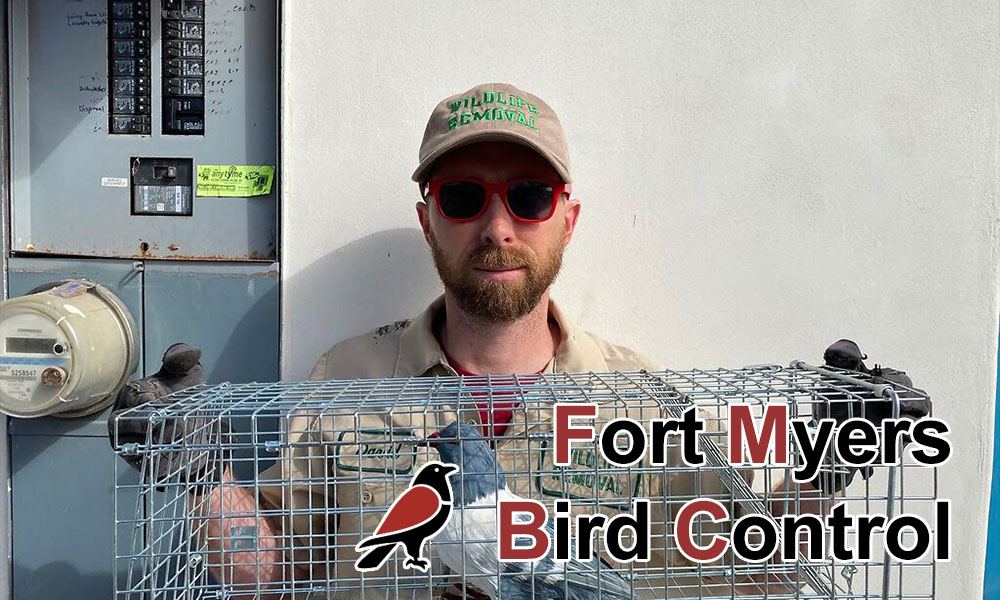
Welcome to Fort Myers Bird Control: Prevention and Removal of Unwanted Birds
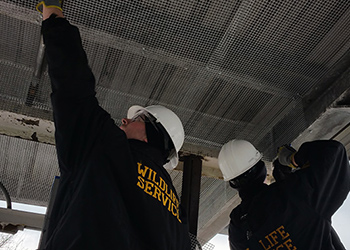
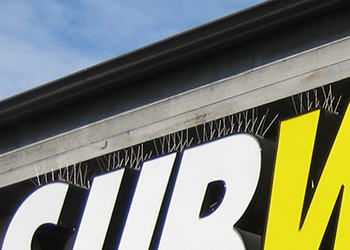
Our company specializes in resolving problems caused by birds in Fort Myers, Florida, both residential and commerical. We handle bird species such as pigeons, starlings, grackles, sparros, and even Canada Geese and woodpeckers. We generally don't kill birds - we prevent them from causing problems. Most commonly, this means that we install barriers that prevent them access to your building or property, or anti-roosting devices that prevent them from landing, nesting, or roosting on your home, store, building, or anywhere. We use netting, needle strips, shock track, and more. We do offer trapping in some cases, and removal of birds from warehouses, grocery stores, or other commerical or industrial buildings by netting or sometimes pellet shooting. We have a wide variety of tools and methods for solving every manner of bird problem. Call us at 239-317-0553 to discuss your bird problem today.Our Work
Full Range of Bird Control Services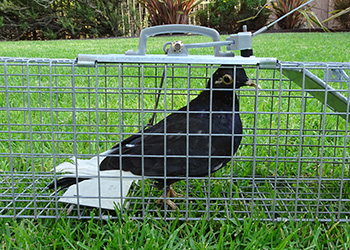
More About Us Fort Myers Bird Control:
Our company is the leading bird removal and exclusion company that will deliver guaranteed results. The satisfaction of our customers is our top priority. We promise that we will effectively and swiftly resolve all your concerns with no hidden charges. We will be steadfast with our commitment to serving you with respect and satisfaction. We will remain faithful to our principles and values that were developed by our founders. We understand that when you call us, you need us to provide a timely service. Therefore, we are operating 24/7 and we will be working diligently until we are sure that all sources and causes of your bird problems have been resolved. With over a decade of experience in providing top-quality results, our company has a solid work history and an unblemished reputation. As proof, we have been voted by the locals as their #1 wildlife removal company for three years in a row. Whether you are a homeowner or you are managing multiple properties, we can provide you with a customized solution. We have always taken the lead in providing the communities with eco-friendly, safe, and reliable bird control methods. We will make sure that these birds will not be a problem for your family and your business.Are Pigeon Nests Protected?
This is a very good question, and it's a question that not enough home and property owners ask BEFORE they take part in any pigeon removal activity.
Do you know what species of pigeon you have living in your backyard? Could it be the white-crowned pigeon, commonly found in a few places in and around Florida, in the United States, and this particular bird is actually classed as "protected". This is a species of pigeon that is endangered within that State, and is covered by not just Florida's Endangered and Threatened Species Rule, but also the U.S. Migratory Bird Treaty Act.
If you don't know what particular species of pigeon you have in your backyard, you shouldn't take lethal action to remove it. If the species is an endangered one, the appropriate authorities will need to be called so that the pigeons can be safely removed and rehomed somewhere they will hopefully flourish.
The chances of you having a State or US-wide threatened or endangered pigeon in your backyard is slim to none, of course. Many of us are privy to just the regular, pest type of pigeon. You might think that the rules that govern the white-crowned pigeon don't apply to the regular pest-type, but that's not the case.
We discussed the U.S. Migratory Bird Treaty Act a moment ago, and we feel it is very important to circle right back to it, because this Treaty Act will have a MASSIVE impact on how you are lawfully permitted to remove pest birds from your property, and we're not just talking about pigeons.
The pigeons that we know as feral pigeons are all derived from pets or tamed pigeons. The "pest" pigeon is not a species of bird that is native to the United States, which means that the pest pigeon — feral pigeon — is not an animal that will be covered by the U.S. Migratory Bird Treaty Act. English sparrows are also included in this list of non-native bird species, and you can also add starlings to it, too. The rock dove or non-feral version of the pigeon, was first introduced to the Americas during the 1600's.
If you live in southern Texas, you may have encountered the red-billed pigeon, scientifically known as Patagioenas flavirostris. This pigeon breed IS covered and protected by the U.S. Migratory Bird Treaty Act.
One of the most widespread North American birds is Zenaida macroura or Mourning dove, and this looks very much like a pigeon. If you were to try and remove any of the birds, their young, eggs, or the nest, or you disrupt them in any way, you would be contravening the U.S. Migratory Bird Treaty Act.
The point we're trying to make here is that it can be easy to instantly assume you have one particular type of animal living in your back garden, when in actual fact, you don't. We have been to properties where a pigeon problem has been suspected and it's turned out to be a different bird, or pigeons alongside different birds. When that is the case, once again, you'll need to check that the other birds in the mix are not covered by the Treaty.
If you are in any doubt which type or species of pigeon/bird you have living in your back garden, always seek out an expert opinion. You never know, that expert opinion might just give you a few tips to shorten the time it takes to have a pigeon-proof property once again.
We have the most experience in Fort Myers at understanding the nuisance birds of Florida. Our 7 years of experience in the field ensures excellent results.
We pride ourselves on the quality of our bird control work. Our work is professional grade and long lasting, usually for the life of the building.
We are fully Florida licensed. We carry the correct safety equipment, and operate in a safe and professional manner to keep your building and people safe.
Call us at 239-317-0553 to discuss your bird problem and our process. We are always responsive by phone. We can usually schedule next-day appointments, and provide written estimates for all our bird work.
Thank you Fort Myers Bird Control for keeping the pigeons off of my storefront. My sidewalks are clean now!
These guys were the only ones who could get a sparrow out of my clothing store. Thank you!
Your goose abatement program has kept my golf course dropping-free. I recommend Fort Myers Bird Control.